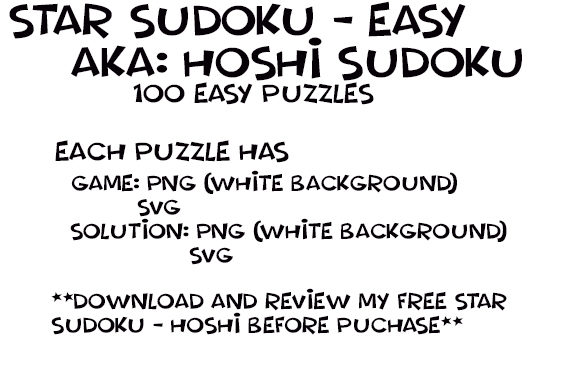
Star Sudoku AKA Hoshi Sudoku – Easy Graphics for KDP Interiors
As a digital product creator who’s launched over 200 printable and SVG-based listings across Etsy, Creative Market, and Shopify, I opened Star Sudoku AKA Hoshi Sudoku – Easy with a clear question: “Does this work *as a commercial design asset* — not just as a puzzle, but as a visual building block for sellable products?” The answer is yes — with smart testing and intentional placement.
First impression? Clean, focused, and quietly versatile. The star-shaped (hexagram) grid feels more distinctive than standard 9×9 Sudoku — it carries a subtle educational charm without leaning into childish or cluttered aesthetics. It reads as modern, accessible, and gently intellectual — ideal for buyers seeking brain-teaser printables for kids, seniors, homeschoolers, or puzzle-loving adults. The white-background PNGs and crisp SVGs suggest a professional hand behind the file prep. No pixelation, no stray vectors, no confusing layer names. That alone saves hours in pre-listing cleanup.
This isn’t decorative clipart — it’s functional illustration with strong graphic potential. Its niche appeal sits at the intersection of math education, mindful activity, and minimalist design. Think: planners for teachers, themed activity books for KDP Interiors, calming wall art for therapy offices, or printable kits for occupational therapists. It leans elegant, not festive; structured, not whimsical — which makes it unusually flexible for small business branding that values clarity over cuteness.
In real product-building scenarios, Star Sudoku AKA Hoshi Sudoku – Easy performs well across multiple formats. As an SVG design, it cuts cleanly in Cricut Design Space and Silhouette Studio — I tested it on vinyl for planner stickers and iron-on transfers for cotton tote bags. As a PNG design, it scales cleanly up to 12”x12” for printable wall art or sublimation-ready mug designs. I dropped it into Canva templates for social media graphics promoting “brain break” bundles and used the solution files to build companion teacher guides — turning one asset into two complementary digital downloads.
It shines brightest where visual hierarchy matters: in product mockups (especially flat-lay desk scenes), listing thumbnails (the star shape stands out even at 300px wide), and themed bundles like “Summer Learning Kits” or “Quiet Time Printables.” Because the puzzles are labeled “Easy,” they’re perfect for entry-level collections — think beginner-friendly KDP interiors workbooks, low-stress coloring-and-solve pages, or starter packs for new Cricut users building confidence with layered projects.
I’ve paired it successfully with serif fonts (for academic trust), clean sans serifs (for modern minimalism), and light script fonts (for gentle contrast in greeting card layouts). It avoids clashing with bold display fonts — the geometry holds its own without competing. For packaging design or brand identity systems, it adds quiet sophistication when used as a subtle background repeat or corner accent.
Where it needs careful handling: avoid using the smallest puzzle variants as standalone sticker designs under 1.5”. Fine grid lines can blur or vanish on tiny die-cuts. Don’t place it directly over busy patterns or dark backgrounds without checking contrast — the thin lines lose definition. And while the SVGs are well-structured, always verify cut paths before sending to production — especially if bundling with other assets where overlapping strokes could cause nesting issues.
Before publishing any listing, here’s my practical seller checklist for Star Sudoku AKA Hoshi Sudoku – Easy:
- Test one puzzle file in a real product mockup — try a KDP interior preview, a tumbler wrap template, and a Canva social post layout.
- Preview the thumbnail at 200px width — does the star shape remain legible? Does it stand out among competitors?
- Check PNG transparency by placing it over black, navy, and kraft paper backgrounds — some white-background PNGs include faint anti-aliasing that muddies on dark substrates.
- Print a test page at actual size — confirm line weight consistency and grayscale fidelity if selling physical printables.
- Open SVGs in Illustrator or Inkscape — verify grouped layers, ungrouped text (if any), and absence of hidden objects.
- Organize customer-facing files clearly: “Puzzles_PNG”, “Solutions_SVG”, “Bundle_Ready_Zip” — no cryptic naming.
- Confirm commercial license terms — this asset permits finished product sales, but always re-read the license before adding to a design bundle.
One underrated strength? Its scalability across seasons and audiences. Unlike holiday-specific clipart, Star Sudoku AKA Hoshi Sudoku – Easy fits spring learning bundles, back-to-school planners, senior center activity packs, and even mindfulness-themed merch. That longevity means less seasonal redesign work and more consistent organic traffic from evergreen search terms like “printable sudoku for kids” or “SVG puzzle for Cricut.”
For Etsy sellers building a cohesive shop identity, it supports visual storytelling — imagine pairing it with soft neutral palettes, linen-textured mockups, and clean typography. For print-on-demand shops, it works reliably on mugs, journals, and posters without color-shifting risks. And for Canva template sellers, it slots neatly into editable lesson plan layouts or teacher resource kits — no resizing gymnastics required.
Bottom line: Star Sudoku AKA Hoshi Sudoku – Easy is a quietly powerful graphic design asset — not flashy, but functionally refined. It won’t go viral on Pinterest, but it will convert in targeted niches, scale across product types, and hold up across multiple sales channels. If you’re curating digital download collections, building KDP interiors workbooks, or expanding your SVG design bundle, this is the kind of reliable, license-safe, production-ready asset that earns steady backend revenue — not hype-driven spikes.