Christmas Shadow Matching Game – KDP
A Designer’s First Look: Playful, Clean, and Quietly Clever
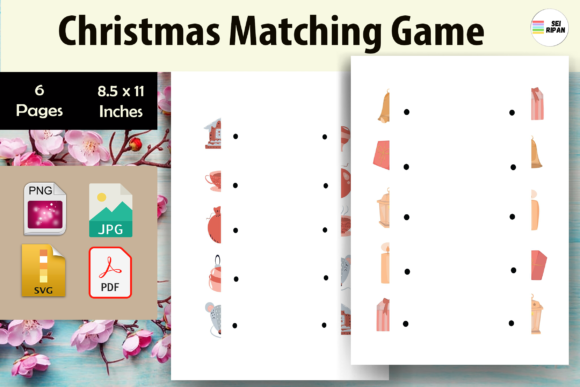
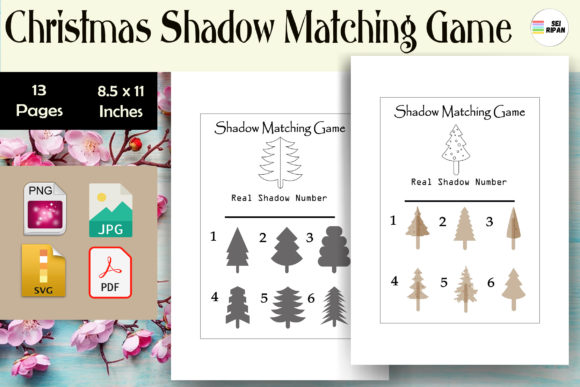
When I opened the Christmas Shadow Matching Game – KDP, my first thought wasn’t “Oh, another holiday graphic”—it was “This could actually work on a baby onesie.” The set feels intentionally restrained: 13 simple, high-contrast silhouettes—reindeer, snowman, gingerbread, tree, bell—each paired with its shadow outline. No gradients, no busy backgrounds, no tiny decorative flourishes. Just bold, friendly shapes with generous negative space. That simplicity is its strongest asset for embroidery—not just as a digital file, but as a *stitchable* idea. It doesn’t shout; it invites quiet interaction. Exactly what you want when stitching for little hands or gifting to new parents.
Where This Design Truly Shines in Real Embroidery Projects
I tested one shadow pair—a jolly snowman and its soft-edged silhouette—on a natural linen tea towel using medium-weight cutaway stabilizer. Stitched at ~3.8" wide, the result was crisp, legible, and warm. No fill-stitch bleeding, no satin-stitch puckering. That tells me the Christmas Shadow Matching Game – KDP was likely digitized with thoughtful stitch direction and moderate density—ideal for home and small-batch embroidery machines.
It’s especially effective on items where subtlety matters: embroidered pillow covers for a nursery, minimalist aprons for a holiday baking kit, or cotton tote bags for a local craft fair. I also stitched a scaled-down version (2.2") onto a newborn beanie—no hooping drama, no thread nesting, and the clean lines held up beautifully even on that slightly curved surface. As a machine embroidery design, it leans into clarity over complexity, which makes it reliable across fabric types and skill levels.
For Etsy sellers and small shop owners, this isn’t just a decoration—it’s a storytelling tool. A customer buying a personalized baby blanket with the “reindeer + shadow” pair isn’t just getting embroidery; they’re getting a gentle logic prompt, a tactile learning moment, and seasonal charm—all in one stitch. That kind of layered value lifts perceived product worth without raising production cost.
Where to Pause—and Test—Before Committing
Don’t assume it’s foolproof everywhere. On dark, heavy fleece sweatshirts, the shadow outlines can visually recede unless you use high-contrast thread (think bright white or metallic silver). And while the shapes are generous, some corners—especially the curved base of the gingerbread man—tighten quickly at under 2". If you’re planning a cap or structured patch, check how those curves translate in satin stitch before final hooping.
Also note: this is a graphics pack—not pre-digitized embroidery files. You’ll need to convert the included SVG, PNG, and JPG files yourself or hire digitizing help. That means stitch density, underlay, jump stitches, and pull compensation are all in your hands. For commercial embroidery or consistent boutique branding, always run a test on scrap fabric first. Try it on both light and dark cotton, then on a textured knit—see how the shadows hold their shape when the fabric shifts under tension.
Practical Notes Every Embroiderer Should Run Through
- Test before scaling: Resize one design in your software and simulate stitch count—avoid pushing below 1.8" unless you’ve verified detail retention.
- Stabilizer matters more than usual: Because the shadows rely on clean edges, skip tear-away on knits—opt for cutaway or mesh for stretchy fabrics like baby jersey.
- Thread color contrast is non-negotiable: Use black thread on cream linen? Yes. Same thread on charcoal terry? Not unless you add a white underlay or switch to ivory.
- Check licensing carefully: Since this is labeled Kdp Interiors, confirm whether resale of finished embroidered goods is permitted—and whether you may include the design in printable mockups for your Etsy listings.
- Review corner radii and internal angles: Some shadow bases have subtle inward curves—these can trap thread if stitch density is too high or needle size too fine.
- Mock it in grayscale: View the PNGs in black-and-white mode to assess true visual weight—what looks balanced on screen may vanish when stitched.
Beyond the Hoop: How It Shapes Your Brand and Customer Experience
As a designer who ships custom embroidered kitchen towels to gift shops across the Midwest, I pay attention to how a design lands emotionally—not just technically. The Christmas Shadow Matching Game – KDP reads as thoughtful, not trendy. It avoids cliché Santas and glitter bombs, which helps small businesses stand out in crowded holiday markets. When customers see it on a handmade apron or baby bib, they register care—not just craft. That builds trust, especially for personalized gifts where sentiment carries the sale.
It also scales gracefully across formats. Use one shadow pair as an embroidered patch on a denim jacket, then repurpose the same vector (SVG) for a printable activity sheet inside a holiday gift box. That cross-format flexibility makes it strong design assets—not just single-use embroidery files. For creative entrepreneurs building cohesive product lines, that versatility saves time and reinforces brand voice: calm, clever, quietly festive.
Final Thought: A Design That Respects the Process—and the Person Using It
The Christmas Shadow Matching Game – KDP won’t wow with flash—but it earns respect through reliability, restraint, and real-world adaptability. It’s the kind of embroidery file you keep in your “go-to holiday folder” because it works as well on a $12 tea towel as it does on a $95 linen pillow cover. It doesn’t ask for special equipment or advanced technique. It asks only that you pay attention to thread, stabilizer, and scale—and rewards that attention with clean, confident results.
If you’re curating embroidery project kits, launching a holiday collection for your craft business, or simply choosing a design that says “I made this with intention,” this set delivers. Just remember: its quiet strength lies in how it behaves *after* the hoop comes off—not how it looks in your design software. Test it. Touch it. Stitch it—then decide.